-
What does IPG make—and why do I keep seeing “IPG fiber laser”?
-
Is IPG duct tape okay for HVAC ductwork?
-
What moisture barrier specifications should I ask for?
-
Can I get liquid waterproofing private label?
-
What ductwork compliance requirements should I plan for?
-
How fast can you actually rush an order?
-
Why is your quote higher than the other place?
Every week, I get an email that starts the same way: “I found IPG and I’m confused.” And honestly, I don’t blame them. If you search for IPG, you might land on the fiber laser company. Search for IPG duct tape, and you’ll end up here. We’re the other IPG—the one making building materials for contractors and distributors.
In my role coordinating rush orders for B2B projects, I’ve handled 200+ jobs where someone needed a straight answer before a deadline. This FAQ is the short version of what I tell those people. If you’re looking for tape, waterproofing, or ductwork specs, pick your question and jump to it.
- What does IPG make—and why do I keep seeing “IPG fiber laser”?
- Is IPG duct tape okay for HVAC ductwork?
- What moisture barrier specifications should I ask for?
- Can I get liquid waterproofing private label?
- What ductwork compliance requirements matter for a spec?
- How fast can you actually rush an order?
- Why is your quote higher than the other place?
What does IPG make—and why do I keep seeing “IPG fiber laser”?
Here’s the thing: IPG is an acronym, and more than one company uses it. The IPG you’ve probably seen with fiber lasers is IPG Photonics. This IPG, the one I work for, makes building materials. Core product lines include waterproofing membranes, sealants, protective coatings, industrial tapes like IPG duct tape, and HVAC components.
So if you’re looking for a fiber laser, you’re on the wrong page. If you’re looking for a supplier that can combine moisture barriers, liquid waterproofing, tape, and HVAC components on one B2B order, you’re in the right place.
Is IPG duct tape okay for HVAC ductwork?
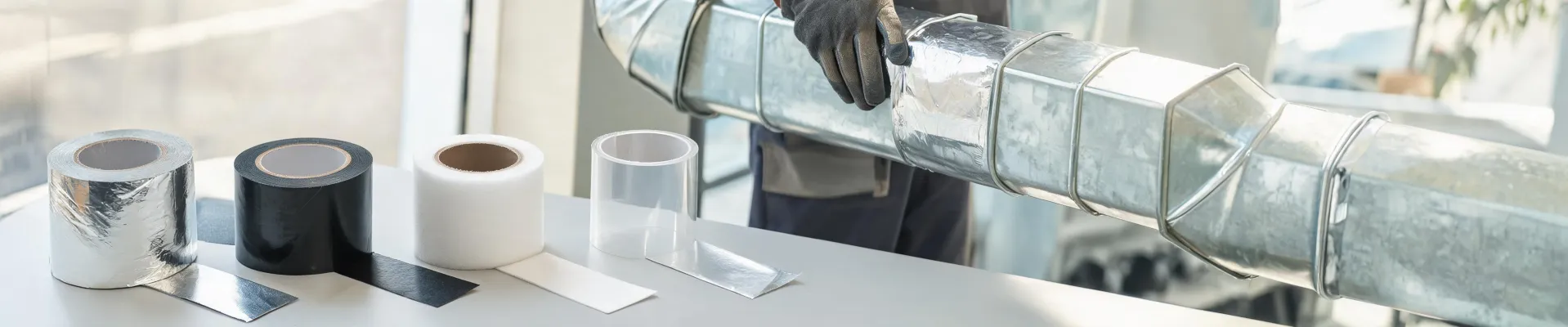
This one makes me cringe, because “duct tape” and “ductwork tape” are not the same thing. General-purpose IPG duct tape is great for packaging, temporary repairs, and some non-code situations. It is not, by itself, the same as the HVAC-rated foil tape we also supply. If you’re sealing supply ducts, the ductwork compliance requirements are specific. Most mechanical codes and SMACNA standards require a closure system with a UL 181A or UL 181B listing. The tape itself has to be marked.
When I compare a standard duct tape with an HVAC-rated foil tape side by side, the difference is obvious: one has the UL label, the other doesn’t. If you ask me for tape to seal ductwork, I’m going to ask who the authority having jurisdiction is, then get you the spec. Don’t use a general-purpose tape on ductwork just because it’s sticky. It fails. Then it fails again.
What moisture barrier specifications should I ask for?
My first answer is always “what’s the application?” I’ve made the mistake of assuming I knew what a client meant by “moisture barrier.” I said “moisture barrier,” they heard “vapor barrier.” Result? We delivered a material with the wrong perm rating. It took two extra days to get the right one.
Actual moisture barrier specifications depend on whether you’re under a slab, on a foundation wall, behind a shower, or above a crawl space. For under-slab vapor retarders, ASTM E1745 is the standard you’ll see. For above-grade or below-grade waterproofing, you’ll often be testing to ASTM E96 for water-vapor transmission. You should get a spec sheet that lists those values. If a salesperson gives you a moisture barrier price without asking where it goes, that’s a red flag.
It took me three years and about 150 orders to understand that specifications beat product names. The product name gets you close. The ASTM standard gets you to the right material.
Can I get liquid waterproofing private label?
Yes. Liquid waterproofing private label is a big part of what we do. We provide OEM/private label support for liquid waterproofing, sealants, and coatings. You put your brand on it, and we handle manufacturing, packaging, and documentation.
But real talk: private label doesn’t mean you skip compliance. If your label says “waterproof,” you need a test report proving it. Per FTC guidelines at ftc.gov, claims have to be truthful and substantiated. That’s not just for environmental claims—it’s for any claim. I’ve had a client show me a competitor’s “waterproof” coating that was really just damp-proofing. That word difference matters when there’s water in the basement.
When I compared two private-label suppliers a few years ago, one had full data sheets and batch traceability. The other had a good-looking bottle. The good-looking bottle failed on a job. Your name is on the label, not the manufacturer’s. Make sure the documentation is as strong as the product.
What ductwork compliance requirements should I plan for?
This is a bigger question than “do I need tape?” Ductwork compliance starts with the building code and the mechanical code your project falls under. In the U.S., that often means SMACNA installation standards plus UL 181 for closure systems. If you’re specifying a flexible duct with a non-metallic outer layer, there’s a different listing. If it’s sheet metal, the tape or mastic still needs to meet the same standard as the duct system.
Here’s a mistake I made once: I knew I should check the local code before ordering, but I thought “what are the odds?” Well, the odds caught up with me when the inspector rejected a shipment because the tape didn’t have the right UL marking. That $400 mistake taught me to send the spec to the vendor before the PO, not after.
When you talk to IPG, tell us the application and your jurisdiction. We’ll help you match the product to the requirement. But we won’t say “the tape” meets all building codes—you need the code, the product listing, and someone to verify it.
How fast can you actually rush an order?
If you’ve ever missed a deadline, you know that feeling. I’ve handled same-day turnarounds for contractors who realized at 3 PM that they’d forgotten the liquid membrane for a morning pour. It’s not cheap, but it’s doable.
One example: in March 2024, a distributor called on a Thursday needing a specific moisture barrier spec for a Monday project. Normal lead was six days. We pulled product from two warehouses, paid $750 in expedited shipping on top of the $4,800 base cost, and delivered by Saturday. Their alternative was missing a $50,000 penalty deadline.
But here’s the thing about pricing: I’d rather show you a number upfront.
According to USPS pricing effective January 2025, First-Class Mail letter (1 oz) is $0.73. Rate changes are published at usps.com/stamps.
You know the cost before you mail it. That’s how quotes should work. We don’t quote low and add “emergency handling fees” later. Ask “what’s not included?” before you ask “what’s the price?”
Why is your quote higher than the other place?
Because I build quote line items. When I quote a moisture barrier, you see the material, the flashing tape, the primer, shipping, and any expedite fee. The vendor who quotes half of what I quote might be planning to sell you the “base product” and then upsell every accessory. Or they may not know the spec yet.
Look, I’ve lost bids to lowball vendors. Twice in one year, we watched a buyer go with a cheaper quote and then come back because the product didn’t meet the moisture barrier specification. That’s the contrast insight. The cheaper quote looks like a deal until the job is stopped. I’m not saying our products are cheap. I’m saying the total cost is usually clearer.
If you give me your application and deadline, I’ll tell you whether the cheap route is worth the risk. And if it is, I’ll still sell you the right material.